Dear Essendon,
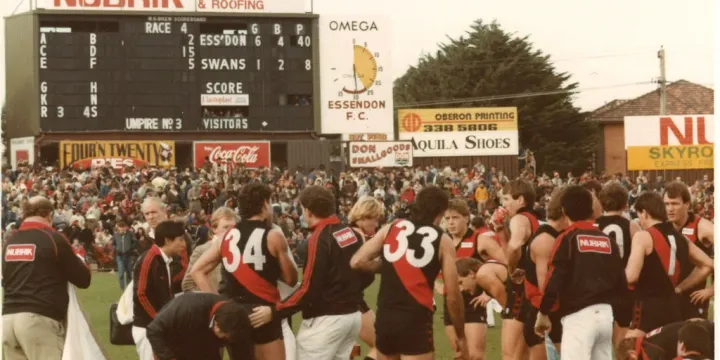
I was ten, maybe eleven. The mid-eighties. A Thursday night practice match at Waverley Park, under the lights, with the wind coming off the southern stand and going straight through you, beanie or no beanie. I had the beanie on anyway. Red and black. And the jumper underneath the jacket because you wore the jumper.
There were four of us. My brother Karl, my dad, my Uncle John and I. Uncle John barracked for Carlton, which the rest of us forgave him for and which never once stopped him coming along. That was the kind of night it was. Cold, half-empty, the smell of liniment drifting out of the rooms, four blokes in a row in the stands or down by the fence, three Bombers and a Blue and nobody anywhere else in the world we'd rather be.
I got chatting to a kid about my age on the boundary and it turned out his old man was the Essendon runner. Next thing I knew I was sitting on the interchange bench. The actual bench. Watching men I'd only ever seen on television move past me close enough to touch.
I don't remember the kid's name. I wish I did. But I remember the bench, and the cold, and the feeling that this was the closest a boy could get to the centre of the world.
My dad had played a bit of footy himself, years before, for Vermont. He was honest about it, said he was very limited. But one of the blokes he'd run around with in those Vermont days was Darren Williams. Daisy. And Daisy had made it. Daisy was a Bomber. Before and after the game that night, Dad and Daisy spoke. Just briefly. A handshake, a few words between two men who had played a bit together a lifetime ago, one of whom had gone on to wear the red sash.
I watched that conversation like it was a religious ceremony. I have never forgotten it.
That is the boy I am writing from. That boy is fifty now. His dad is gone. His brother still wears the red and black. His Uncle John, well, his Uncle John was always allowed. That boy has lived through every Essendon era a man can live through: the Sheedy years, the Hird years, the long climb and the long fall. He has watched James Hird play football that didn't seem possible. He has watched 1993, and 2000. And he has watched 2013, and what came after.
That boy is still in me. He is why I am writing.
Dad never forgot the club he loved. In our house, as kids, it was always Essendon. The footy was on the radio in the kitchen and on the television in the lounge. If we'd been to the game, we watched the replay anyway, every kick, again, as if the second viewing might change something or fix something or simply make the day last a little longer. Karl and I would sit on the carpet in front of it, in our jumpers, with Dad in his chair behind us, calling (possibly yelling) out at the screen as if the umpire might hear him this time.
Christmas dinners and family gatherings turned, sooner or later, into long and sometimes heated discussions about the Bombers, about the week just gone, the bloke we'd just played, what Sheedy was thinking, what he should have been thinking. Carlton was a serious subject. So was Hawthorn, in the years they were good enough to be a serious subject. But above all and beneath everything, was Collingwood. Beating Collingwood was its own category. It didn't matter who was doing it, Essendon, Geelong, the Swans, anyone beating Collingwood was, briefly, family.
This is the part that is hardest to explain to people who didn't grow up inside it. The club was not a thing we watched. It was a thing we belonged to. It belonged to us back. It was a covenant and it was kept on both sides. We turned up, in the cold, on Thursday nights, in front of the television, on our way home from either golf or basketball with the radio on, or around the dinner table. And the club turned up, by playing football the right way, by standing for something, by being a place a father could hand to his sons without flinching.
Sheedy understood that covenant. So did Daisy Williams, briefly shaking my dad's hand on a windy night at Waverley. So did the men who built the club from country towns and working-class suburbs and the long memory of premierships earned the hard way.
The covenant is what I want to talk to you about. Because the covenant is what is now on the table.
So let me ask the question this letter exists to ask. Has the club forgotten?
Because I haven't. And I don't think I'm allowed to.
In 2011 and 2012, something happened inside our club that broke the covenant from the inside. Not a bad season. Not a poor recruiting year. A betrayal of the one thing a football club owes the young men who walk through its doors: their health, and the truth about what is being done to their bodies.
The club's own review, commissioned by Essendon, not forced on it, described what it found as a pharmacologically experimental environment, never properly controlled, never properly documented. Read those words again slowly. Our club. Experimental. On our players. The man who had warned them in writing, Dr Bruce Reid, the doctor who'd looked after Bombers since '82, who players called Reidy, who is now in our Hall of Fame as a Legend, was pushed to the side while it happened. He saw it coming. He put it in a letter. He was marginalised anyway.
And then there were the players. Thirty-four of them, eventually banned. We remember the famous ones. But I want you to remember the others. Hal Hunter, a rookie who never played a senior game, who had to take Essendon, his own club, to the Supreme Court of Victoria just to find out what had been injected into his body. Sit with that. A young man had to sue the club he'd dreamed of playing for, to learn what was in his own blood.
Remember Cory Dell'Olio, Brendan Lee, Alex Browne, kids who were never stars, whose modest careers were already hanging by a thread and whose two-year bans followed them down into the suburban and country leagues where they'd gone to keep playing the game they loved. The bans didn't care that they weren't famous. They wiped out seasons in the WAFL, in the bush, for men who had already given the club everything they had and gotten very little back.
Mark Thompson, a premiership coach and himself far from blameless, came out the other side of it broken, a man who later told the world the saga sat in his guts and churned and that he thought it would end up killing him.
This is not ancient history. This is not a bad memory we are entitled to file away. This is the fabric of the club, torn and never fully rewoven. The damage was not done to a logo. It was done to people. Some of them never recovered.
So I ask again, and I mean it as a once passionate supporter, not a critic: Has the club forgotten?
And now James Hird has put his own hand up.
Not the club, at least, not yet, not on the record. The man himself. On television, on the night Brad Scott was sacked, James Hird sat on a panel and said that if Essendon asked him to coach, he'd say yes. He didn't wait to be courted. He nominated himself, in front of the country, while the seat was still warm.
So the question is no longer hypothetical and it is no longer only about him. It is about us. Because a man can ask for anything he likes. The real question is whether this club, our club, would say yes. And I am writing to say what I hope, with everything that boy on the interchange bench still has in him, we will not.
I want to be careful here, because this is where people stop listening. So let me say plainly what I am not saying. I am not saying James Hird is a bad man. I am not saying he didn't suffer. He suffered enormously, and the night in early 2017 that nearly ended his life is a tragedy no supporter should take lightly. I am not saying he was the only one at fault or even the most culpable. He wasn't.
I am saying he should not be the senior coach of this football club. And I am saying the reasons are not about football. They are about the covenant.
Start with accountability, and let me be specific, because the detail is where this matters.
Before the program began, the players were brought into the club auditorium and asked to sign consent forms. Consent forms, for injections. Think about what that means. You do not gather grown men into a room and have them sign a form consenting to be injected with substances unless you know, with certainty, that an unusual program is about to be run on their bodies. And the forms went further: they asserted the treatment was compliant with the anti-doping code. You do not certify that something is compliant unless the question of compliance has already crossed your mind. James Hird was in that room. He was, on the evidence given in court, among those who assured the players the program was above board.
So when James Hird says he didn't really know what was going on, I find that very, very hard to accept. Not because I can prove what was in his mind, no one can, and the Court of Arbitration for Sport never found that he knew the substances were banned. But a man who helps organise signed consent forms for an injecting regime and who personally reassures the players it's compliant, does not get to also claim he was a bystander. You cannot be the one giving the assurance and the one who didn't know, at the same time. One of those positions has to give.
And look at what followed. Across that period there were thirty ASADA testing visits. Every time, the players were asked whether they had taken any supplements. Not one of the players tested ever declared the injections. The team doctor, Reidy, the man who'd warned them in writing, was kept outside the loop. ASADA's own chief executive said it plainly: at best the players didn't ask the questions they should have; at worst, they were part of a culture of secrecy and concealment. Secrecy and concealment. That is not the language of an innocent mistake. That is the language of a program that knew it had something to hide, and a club, and a coaching group, that built the silence around it.
Then sit the apologies beside all of that. In 2016, "a level of responsibility." In 2022, he'd trusted "bad people," but still didn't believe the players took anything wrong. In 2026, the mistakes were "partly" his. Thirteen years on and the script barely moves. Always the oversight, never the substance. That is not contrition. That is a position, held with discipline, for over a decade. And a man who organised the consent forms, who gave the assurances, and who still cannot say plainly that his players were given something they should never have been given, that is not a man who has reckoned with what happened. He has managed it.
And here is the moment that tells you everything. After the final verdict, asked about who bore responsibility, James Hird turned toward Dr Bruce Reid. Not to thank him. To suggest that Reid, too, should have done more, that he wasn't sure Bruce had taken enough responsibility. Sit with the gall of that. Bruce Reid was the one man inside the club who saw it coming and put his warning in writing. He was sidelined for his trouble. He was charged by the AFL and refused to settle when others did, and the charges against him collapsed. He is in our Hall of Fame as a Legend. And the coach who presided over the program that ignored Reid's warning reached, in his hour of reckoning, for the doctor's name to help carry the weight. A man secure in his own account of events does not do that. A man still managing the story does.
Then there is the duty of care, the one that matters most to me, because it's the covenant in its purest form. A senior coach owes his players their welfare. That debt does not expire when a suspension ends. It is owed forward, for life, to the men most damaged. So I ask a simple question, and I have looked hard for the answer: in the years since, what has James Hird actually done for them? Not the public regret. The concrete acts. Did he stand beside Hal Hunter when that young man sued the club for the truth? Did he advocate for Dell'Olio, for Lee, for the kids whose careers the bans erased in the bush and the WAFL? If he did, it is nowhere on the public record. The men who needed the senior coach's voice the most appear to have received his silence.
And finally, there is the message. If this club were to hand the senior job to the man who presided over the worst governance failure in the history of this game, it would be saying something to every parent who is about to trust a club with their son. It would be saying: it doesn't matter. Be good enough as a player, be loved enough as a legend, and the system will bend back into shape around you, no matter who got hurt on the way. That is the exact opposite of the lesson the saga should have taught us. And it would be the covenant, broken a second time, this time as a choice.
I started this letter on an interchange bench at Waverley Park, on a cold Thursday night, with my brother beside me, my Uncle John forgiven his Carlton sins, and my dad a few feet away shaking hands with a man who'd made it to the red and black. I told you that boy is fifty now and that his dad is gone.
Here is what I didn't tell you. When my father was dying, the club was still in the room. Not literally, but in the way it always had been, the way it was on the carpet in front of the replay, the way it was at every heated Christmas dinner. Essendon was one of the threads that ran through his whole life and tied it to mine and to Karl's. That is what a football club is, when it's done right. It is the thing a father hands his sons that outlasts him.
So when I ask whether the club has forgotten, I am not asking a rhetorical question. I am asking whether the thing my father handed me still means what he believed it meant. Whether the covenant, turn up for us and we will be something worth turning up for, still holds. Or whether it can be quietly set aside the moment a famous enough name puts his hand up on television.
I don't hate James Hird. I cheered him as loudly as anyone who ever pulled on the jumper. I can still see the goal he kicked against West Coast in 2004, snapped off his right boot from a tight angle in the dying seconds, the whole place coming apart, Hird running to the fence and throwing his arms around a stranger in the crowd because the feeling had nowhere else to go. I was that stranger in spirit and so was every one of us. Part of me, the boy on the bench, still wants the story to end with him lifting us back up. But wanting it does not make it right. And love for a person is not the same as love for a club. The club is bigger than any one man, even him. Especially him. That is the whole point of a club.
If we bring him back, we will not be honouring our history. We will be confessing that we never really learned from it. We will be telling Hal Hunter and Cory Dell'Olio and Brendan Lee and Dr Reid, and every kid who ever signed a form he didn't understand, that none of it counted in the end.
I am asking us not to do that.
Not for James Hird's sake. For ours.
Go Bombers.